
For car rental operators, third-party distribution can open access to customers who might otherwise book through a competitor. But the value of each channel depends on more than booking volume. Commercial terms, payment methods, customer segments, and the quality of product information can all affect net revenue per booking.
By Hannes Põldvee, Product and Sales Manager at Car Rental Gateway
Airlines, online travel agencies (OTAs), and other travel sellers source rental cars in different ways. Some prefer direct relationships with operators, while others rely on brokers and aggregators to extend their reach. Many combine both, balancing direct partnerships with broader distribution coverage.
These choices influence how operators connect with partners, manage accounts, and tailor rates, content, and ancillary products to specific channels. Differences in customer expectations, payment processes, and content consistency can also affect conversion, operational costs, and the revenue retained from each booking.
Understanding how travel retailers evaluate direct, broker, and hybrid models helps rental operators assess the commercial and operational implications of each relationship: from connectivity and channel management to partner collaboration and profitability.
This article explores these trade-offs from the travel retailer’s perspective and what they mean for car rental operators building effective, profitable distribution partnerships.
Car Rental Distribution: Direct, Broker or Hybrid?
Car rental can be a valuable addition for airlines, OTAs and other travel retailers, but it means taking on more than just another booking category. It requires access to supplier inventory, accurate product information, reliable booking processes, and the ability to handle changes, cancellations, payments, and customer service.
Choosing the right distribution model therefore means looking beyond commission to commercial control, customer experience, supply coverage and the cost of running the distribution business.
There are several ways to build this capability. Travel retailers can integrate directly with rental companies, source inventory through a broker or aggregator, use GDS connectivity, or combine multiple supply sources. They can also maintain direct supplier agreements while outsourcing the underlying connectivity and distribution technology to a specialized platform.
Each approach balances control, cost, supply coverage, and complexity differently. The right choice depends on booking volumes, target markets, commercial objectives, and how much of the rental customer journey a retailer wants to own.
Direct Distribution: More Control, More Responsibility
With direct distribution, a travel retailer contracts with rental companies and sets up the commercial and technical arrangements needed to sell their inventory.
The main attraction is control. Where supplier agreements allow, the retailer can negotiate commercial terms, manage prices, shape the customer journey, and decide how to merchandise and promote rentals, including which ancillary products to offer.
Direct relationships can also create opportunities to differentiate offers, combine rental with other travel products, and retain more of the margin that might otherwise be shared with an intermediary.
But direct distribution is not cost-free. Every supplier relationship requires commercial management. The retailer must build, test, and maintain each integration. The retailer must map and monitor product content, vehicle classifications, rate rules, and booking conditions. The retailer must also decide how it will handle booking changes, cancellations, payment flows, reconciliation, and supplier performance.
These responsibilities do not disappear once an integration goes live. Supplier APIs change, business rules evolve, and operational exceptions still need to be resolved.
For a travel retailer with substantial rental volumes and the resources to support them, the investment may be justified. For a retailer newly entering the rental market or serving relatively few customers, the cost of building and maintaining the necessary capabilities may outweigh the additional commercial return.
The key question is not whether direct distribution offers a higher margin, but whether that margin covers the full cost of running it.
Broker and Aggregator Distribution: Speed and Reach
Brokers and aggregators allow travel retailers to access multiple rental suppliers through an intermediary relationship or technical connection.
This can efficiently launch a rental offering, expand geographic coverage, and reach suppliers that would be difficult to integrate individually. Rather than building and maintaining every connection itself, the retailer can rely on the intermediary for some combination of supply access, content normalization, booking connectivity and operational support.
In return, the retailer gives up some margin and may have less influence over product presentation, pricing, customer data or the post-booking experience. How much depends on the contract and the role the intermediary plays.
An intermediary may also provide valuable services that would otherwise need to be built in-house. Weigh its commission or margin against the cost of doing the work in-house, rather than treating it as an automatic loss.
For businesses testing demand, launching quickly, or prioritizing broad coverage, this model can be attractive. What matters is whether the commercial terms and level of control will still suit the retailer as its rental business grows.
Hybrid Distribution: Flexibility With Added Complexity
A hybrid model mixes direct supplier relationships with supply from brokers, aggregators, or GDSs. An OTA, for example, might connect directly with major rental brands in its core markets and use brokers for smaller or regional ones.
This approach can balance commercial control with broad supply coverage. The challenge is getting different systems and offers to work together consistently.
Sources may return duplicate vehicles, inconsistent product data, varying prices, and conflicting booking conditions. Handling this internally usually means building a backend orchestration platform. It needs to deduplicate inventory, translate supplier protocols, compare offers like for like, and coordinate post-booking processes.
As the number of suppliers, integrations, and exceptions grows, the engineering and operational burden can become a high hidden cost. Without the right controls, inconsistent data and disjointed booking workflows can also harm the customer experience.
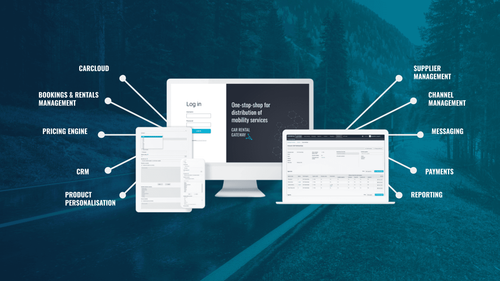
A car rental connectivity and distribution platform can ease this burden by providing a single API for direct and broker connections, with built-in standardized messaging and data normalization. Retailers can then combine direct relationships with wider broker coverage without building every integration and orchestration capability themselves.
The decision comes down to whether the extra revenue and control justify running hybrid distribution internally, or whether a connectivity platform can deliver the flexibility needed more efficiently.
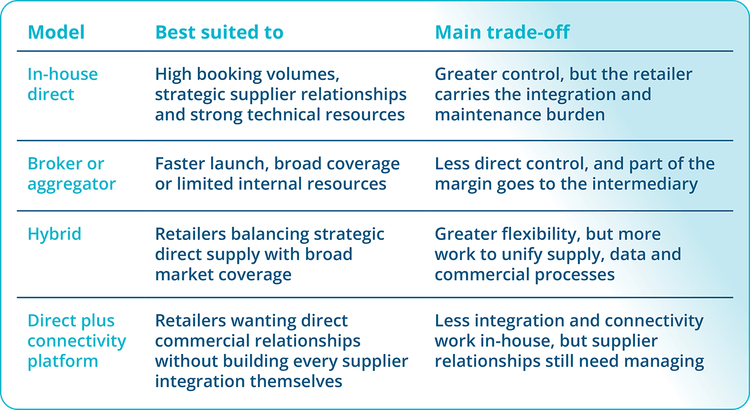
Comparing car rental distribution models. From the travel retailer's perspective, each distribution model offers different advantages depending on booking volume, market coverage, technical resources and the level of commercial control desired.
Direct Supply Without the Integration Burden
Distinguish between owning the commercial relationship and owning the technology behind it.
A travel retailer can contract directly with rental companies while using a third-party connectivity platform to handle the technical side. Instead of building and maintaining a separate integration for every supplier, the retailer connects through a single API.
Depending on the platform and supplier capabilities, this approach can provide standardized data, consistent booking messages, localized content, and a unified way to manage supplier connections. Supplier agreements remain direct, while some technical development and maintenance work is outsourced.
This does not eliminate the need to negotiate contracts, manage suppliers or resolve commercial disputes. Nor does it guarantee that every supplier supports identical functionality. It does change where the technical work takes place and how much of it the retailer must handle itself.
For retailers seeking greater commercial independence without building a large connectivity operation, this can offer a practical middle ground between fully in-house direct distribution and broker-led sourcing.
Compare the Economics, Not Just the Commission
The financial comparison should cover the full cost of running each distribution model, not just commission or headline margin.
For direct supply, costs may include integration development, technical maintenance, supplier and content management, payment processing, customer support, reconciliation, and compliance.
For broker supply, costs include the intermediary's commission or margin, any transaction or platform fees, and whatever work the retailer still handles. A hybrid car rental distribution model carries both sets of costs, plus the extra work of managing multiple sources.
A simple contribution calculation can help frame the decision: The same assumptions should be used for each model being compared. The calculation should also reflect differences in supply coverage, conversion, ancillary revenue, and the resources each model requires.
Not every benefit is captured by a simple per-booking calculation. Greater control over the customer experience, access to booking data and flexibility in merchandising may create additional strategic value. These benefits should be assessed realistically, not assumed to lead automatically to higher returns.
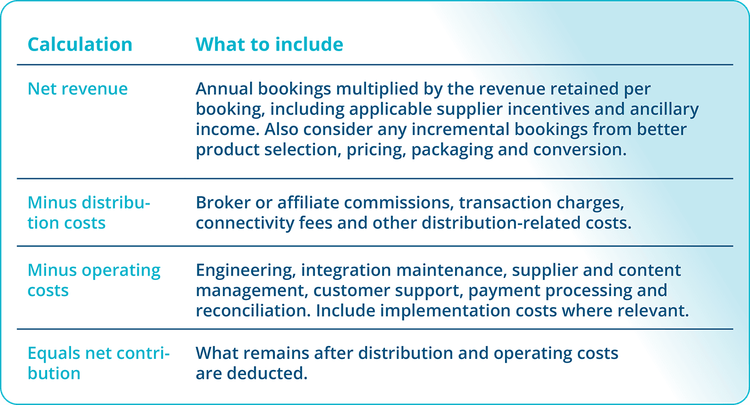
Calculating net contribution from rental distribution. From the travel retailer's perspective, this calculation helps compare the financial contribution of direct, broker, and hybrid rental distribution models after accounting for distribution and operating costs.
Consistent Supply Data Supports the Customer Experience and AI Readiness
Whatever distribution model it chooses, a travel retailer needs consistent, reliable rental data to deliver a smooth customer experience and make sound commercial decisions.
Customers must be able to compare vehicle classes, prices, deposits, excess, mileage allowances, fuel policies, cancellation terms, driver requirements, pick-up arrangements, and available extras across suppliers. Inconsistent terminology or missing information makes comparison difficult, undermines trust, and can generate avoidable customer-service costs.
Reliable data also supports better pricing, ranking, and merchandising. When retailers combine rentals with flights, hotels, and other travel products, they need accurate product information and dependable booking processes to create relevant offers based on factors such as destination, arrival time, and trip duration.
Structured, unified data is an important foundation for AI adoption. AI can support personalization, product recommendations, pricing analysis, demand forecasting, and customer service. But if supplier data is fragmented, the resulting comparisons, recommendations, and insights will be unreliable.
Standardizing vehicle classifications, rates, inclusions, policies, supplier identifiers, and booking statuses makes information more consistent and easier to use across the business. This brings immediate gains in product transparency and commercial decision-making while laying a stronger foundation for connected-trip offerings and future AI applications.
A connectivity and distribution platform can help normalize data and booking processes across direct and broker channels, reducing fragmentation. However, connectivity alone does not guarantee data quality or AI readiness. Retailers must still validate content, manage data access and privacy, and assess the reliability of AI-generated outputs.
Choosing the Right Distribution Model
No single distribution model is right for every business. The best fit depends on its objectives, resources, target markets and stage of development.
Before choosing, travel retailers should assess expected booking volumes, supplier concentration, target markets, ancillary opportunities, customer-service requirements and the resources available to support car rental. They should also establish who is responsible for the customer relationship, payments, modifications, refunds and reconciliation under each arrangement.
Retailers already selling car rental may not need to replace their existing model entirely. Instead, they could adopt a different structure for selected suppliers or markets as volumes, costs and strategic priorities change.
The Objective Is Commercial Control Without Unnecessary Complexity
Direct, broker and hybrid car rental distribution models each have a legitimate role. Direct supply can provide commercial flexibility and closer supplier relationships. Brokers and aggregators can extend reach and reduce the work of setting up supply. Hybrid models let retailers combine these advantages, provided they can manage the added complexity.
Connectivity platforms offer another option, letting retailers keep direct commercial relationships while outsourcing much of the technical work of connecting suppliers and managing their data.
The aim should be to build a rental offering that is commercially sustainable, operationally manageable, and consistent for the customer, not simply to maximize direct contracts or minimize intermediary fees at any cost.
The strongest distribution model gives the retailer the control it needs, the coverage it requires, and a cost structure that still works as it grows.
Explore new car rental distribution opportunities with Car Rental Gateway. Contact Hannes Põldvee at hannes.poldvee@carrentalgateway.com to discuss your supplier connectivity needs and find the right distribution approach for your business.