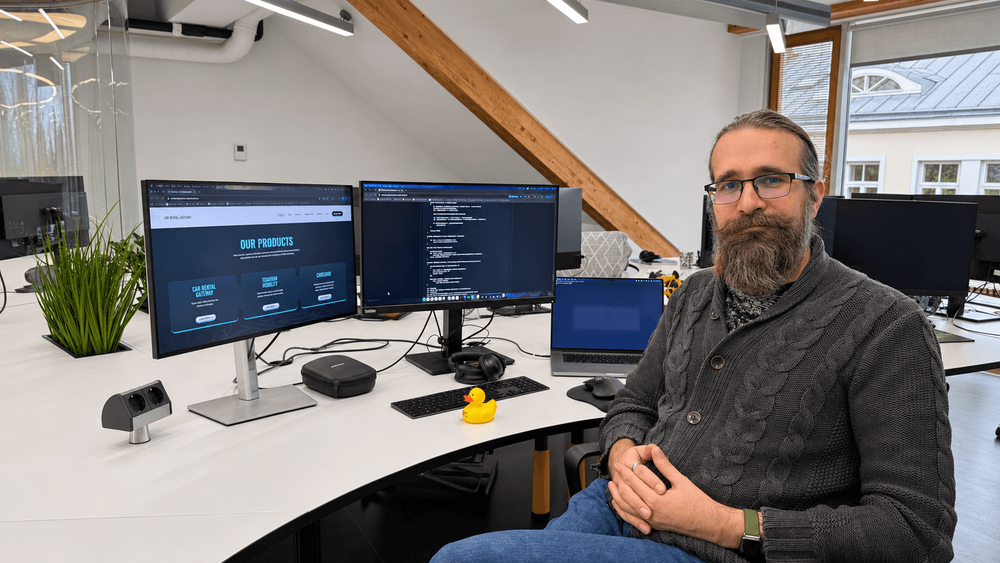
Three months into his role as a full-stack developer at CRG, he describes a change in what takes his attention. As more of the surrounding business logic becomes familiar, he can focus more on the problem itself.
Structure at the start
Asko had wanted a closer relationship with the code and product. His daily work at Car Rental Gateway involves maintaining code, fixing issues and adding features. What stayed with him from the first week was the sense that structure and documentation were already in place.
“It felt refreshing coming in from a world of projects, where sometimes you have a Confluence set up but sometimes there isn't even a readme.”
He describes his developer onboarding as well structured and tailored. Meetings lined up with what he was learning, helping him understand the company, the people involved and why the code behaved as it did.
He singles out the relationship with his assigned mentor as the help he has drawn on most. “Don’t understand the problem? Just ask across the table.” The conversations cover choices between solutions as well as questions about the problem itself. Documentation and questions to the team also help him find his way through the code; he uses large language models to dig through it too.
The rules behind the email
His starting point for the email task was blunt: “Please read the task.” That meant going through every line of the requirements and asking his mentor about anything unclear.
The four-hour requirement was only one part of the work. He also needed a new email template and logic to find the customers who should receive it. Then there was the question of which data went into the message and where that data came from.
To work out where to make those changes, he needed to find the repositories involved and examine what the existing code did and how it worked.
His approach came from his mentor’s advice and team discussions. At that stage, the business logic was entirely new to him. The mentor’s role extended from clarifying the requirements to helping him decide how to approach the implementation. He used the development environment and logging to check the work.
Experience with unfamiliar code
Starting in someone else’s codebase was familiar territory. Before CRG, Asko had worked on JavaScript and PHP projects where he might encounter years-old code and a framework he had only just looked up. That experience is what he says he has drawn on most.
On a project for a startup in infrastructure construction management, he learned to break weeks of work into manageable tasks. He might plan a database structure in the morning, design an interface in the afternoon and spend the next few days implementing everything between them. After that project, he considered himself a full-stack developer.
He had grown up playing PC games and getting computers to run the way he wanted. His studies were in biology. Digitising biology textbooks was the first time he needed coding for work. He used JavaScript for small self-assessment exercises alongside the texts and Python to automate other tasks. He enjoyed that work enough to apply to Vali IT. The C# he learned there is now long forgotten, he says, but the principles and work experience helped him find a place in IT.
Asko has also taught Japanese. Asked what carries over from that work, he points to being able to express the same ideas in Estonian, English and Japanese, whether saying something is not red or asking for coffee. He makes a similar comparison with programming languages: beneath their different boilerplate and conventions, he sees familiar if statements and for loops.
Having started on the frontend, he still enjoys visible results. Seeing and touching his work, he says, “really tickles my monkey brain”.
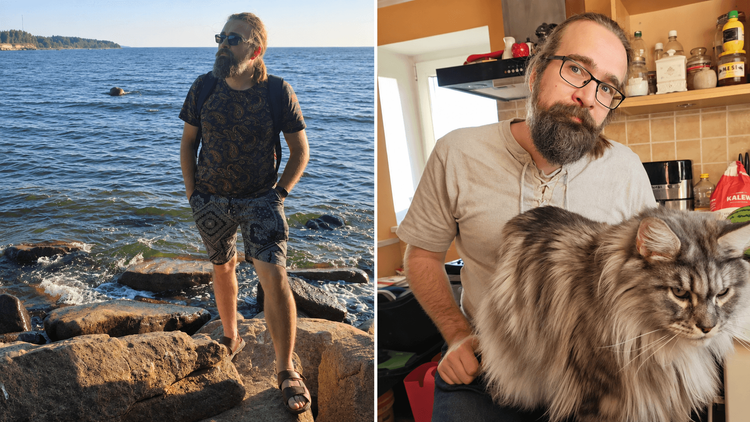
Away from the keyboard: sea air and good company.
Code that another person can follow
Two highly skilled developers with very different habits helped shape his view of readable code. One seemed to expect everyone to have a metre-long display and treated line-length limits as optional; another handed over a codebase with files averaging about 3,000 lines. “Good code is not just clever and functional, it is readable.”
His measure of a job done well is whether data flow and the relationships between parts are easy to follow. If both approaches are technically sound, Asko generally favours the view of the developer with more time on the project. They may have a better sense of its style and background, he reasons. Keeping that style consistent matters to him.
Asko reads and uses AI to weigh pros and cons when choosing an approach. If the options are otherwise equal, he prefers the one he knows better. In disagreements, he also leaves room for his own expertise and asks how much the difference matters.
Three months in, more still to understand
Asko describes his working day at Car Rental Gateway as more structured than he expected, with a clear start and finish. He enjoys being able to talk with colleagues outside video meetings, and his home office has returned to personal projects and hobbies. Away from work, he likes sci-fi on paper or film, the occasional anime, video and tabletop games, and long walks in pretty places.
His confidence in working independently has grown quite a lot since the first weeks. Asko can now point to parts of the code and repositories where he understands what they are, why they exist and how they work. “I feel like I’m tackling the problem rather than tackling the business logic more and more.”
That progress still leaves plenty to learn about the product. As he puts it: “So far behind every major thing I have figured out I have found a new layer of complexities and history. It can be very rewarding but also a bit challenging.”