


Before that, he graduated from kood/Jõhvi, which gave him a practical entry into the field. That background still shows in the way he talks about development. He is not drawn to big statements about technology. What matters more to Timo is whether the work stays interesting, whether there is something real to solve, and whether he can keep learning from it.
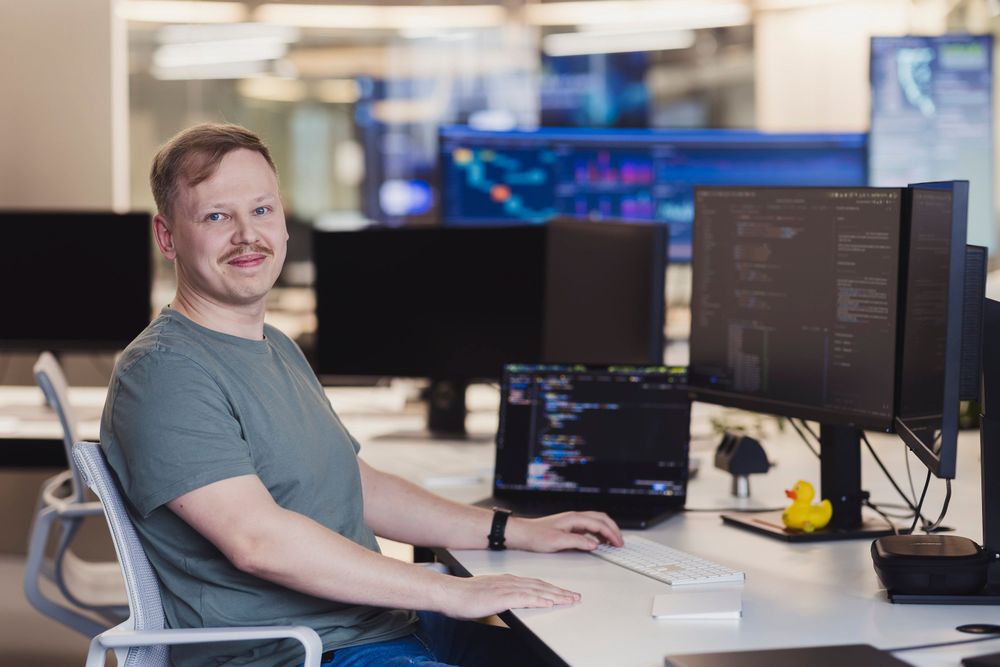
At Car Rental Gateway, he works as a backend developer. The role suits him because the work is not limited to one small area. He may spend one part of the day working through backend logic, another looking into a database issue, another tracing a bug through a larger system to understand where something actually starts going wrong, and at times also working on payment service provider integrations. It is a good example of how the role often goes beyond one narrow task and involves understanding how different parts of the system connect.
The wider tech environment also adds to that variety. Developers at the company work with a broad stack that includes PHP, Node.js in both Typescript and JavaScript, Go on the backend, Vue.js on the frontend, Flutter, MariaDB, OpenSearch and AWS EKS. Over time, Timo himself has additionally worked with tools such as PostgreSQL, MySQL, Docker, Yii2, and Symfony, but he does not define the work through a list of technologies. For him, the more important part is that the job keeps changing shape just enough to stay engaging. It also helps that the everyday setup supports the work in a practical way, with modern developer tools like IntelliJ IDEA or VS Code depending on personal preference, as well as access to AI coding assistants such as Claude Code and GitHub Copilot.
“You deal with many different things here, so you have to keep developing all the time,” Timo says. That idea comes up again and again in how he describes the role. He does not seem especially interested in work that becomes predictable too quickly. In an earlier setting, he found that once the main patterns were clear, the job started to feel repetitive. At Car Rental Gateway, that has been less of an issue. The systems are broad enough, and connected enough, that understanding them fully takes time. For him, that is part of the point.
A Role That Takes Time
Timo speaks about complexity in a calm and practical way. He is not praising it for its own sake, and he is not suggesting that complicated automatically means better. What he values is that the system has enough depth to keep rewarding attention. There is always more context to pick up, more links between different parts of the system to understand, and more reasons behind earlier decisions.
“At CRG, it takes about two years for a developer to really understand where they are,” he says. That could sound discouraging in another context, but he does not mean it that way. He sees it more as an honest description of the environment. The work takes time to understand, and that can be demanding, but it also means a developer is less likely to feel that they have seen everything after a few months. For someone like Timo, that matters. He likes work that continues to open up over time.
Timo: “You don’t get bored here. You keep discovering things for years.” That is probably the clearest way to describe what keeps him motivated. He is interested in technical depth, but also in the process of making sense of a system. Why is it built this way? Why does one change affect another part? What is the actual cause of the issue, not just the visible result? These are the kinds of questions that seem to hold his attention.
The role also fits people who are comfortable with gradual growth. It is not a job where everything becomes obvious quickly, and that is part of why Timo finds it worthwhile. He likes that the work keeps asking for more thought, more patience and a better understanding over time. “If challenges appeal to you, there is a lot to learn here.”
What Makes the Work Fit
Part of the fit also comes from the day-to-day environment. Timo prefers working onsite, and he speaks about that in a straightforward way. For him, being in the office makes it easier to focus, easier to exchange information quickly, and easier to keep work and home separate.
“If you work from home, it’s much harder to be just as productive,” Timo says. He does not frame that as a general rule for everyone. It is simply what works better for him. In his view, being onsite helps keep communication more direct. Small questions get answered faster, information moves more naturally, and it is easier to stay in the rhythm of the day. Just as importantly, when the day ends, it is easier to leave work behind and switch into personal time.
That practical way of looking at things seems to carry through everything he says about development as well. He is not trying to turn the job into something bigger than it is. What he values is fairly concrete: interesting problems, enough technical depth to keep learning, and a working environment that helps him do the job well.
In that sense, Timo’s path into software development has a certain consistency to it. He came into the field through kood/Jõhvi, built his skills through hands-on work, and ended up in a role where the learning does not stop after the basics are in place. For him, that seems to be enough. The work stays varied, the systems take time to understand, and there is still more to discover than he knew when he started. That, more than anything else, is what has kept him interested.
***
Sounds interesting? Take a look at our job openings.